
Walker County Wanted Notices
Walker County has no stable, dedicated Most Wanted page from the sheriff's office. Nothing works as a standing roster. There is no fixed count of names, no published refresh schedule, no searchable archive, and no confirmed photo policy. That gap matters. A page with a "most wanted" heading and no agency behind it may be a recycled list, a different Walker County, or a private publisher's own label.
The WCSO homepage is the best official starting point. It links to the office's Facebook presence, where wanted notices sometimes appear when the sheriff needs the public's help. Those notices are episodic. A post can be corrected, pulled down, or left up after the person is found. So it works as a dated public safety notice, not a live warrant database. Do not expect a public wanted-photo collection from WCSO either, since none has been established.
Plenty of active warrants never show up in a public notice at all. Someone can have a warrant without ever appearing in an agency post. Always confirm current status with the sheriff's office or the court before drawing any conclusion.
For a sense of what the sheriff's web presence does offer, an official report index helps. The WCSO Daily Jail Reports index is a report landing page, not a wanted list or photo collection.
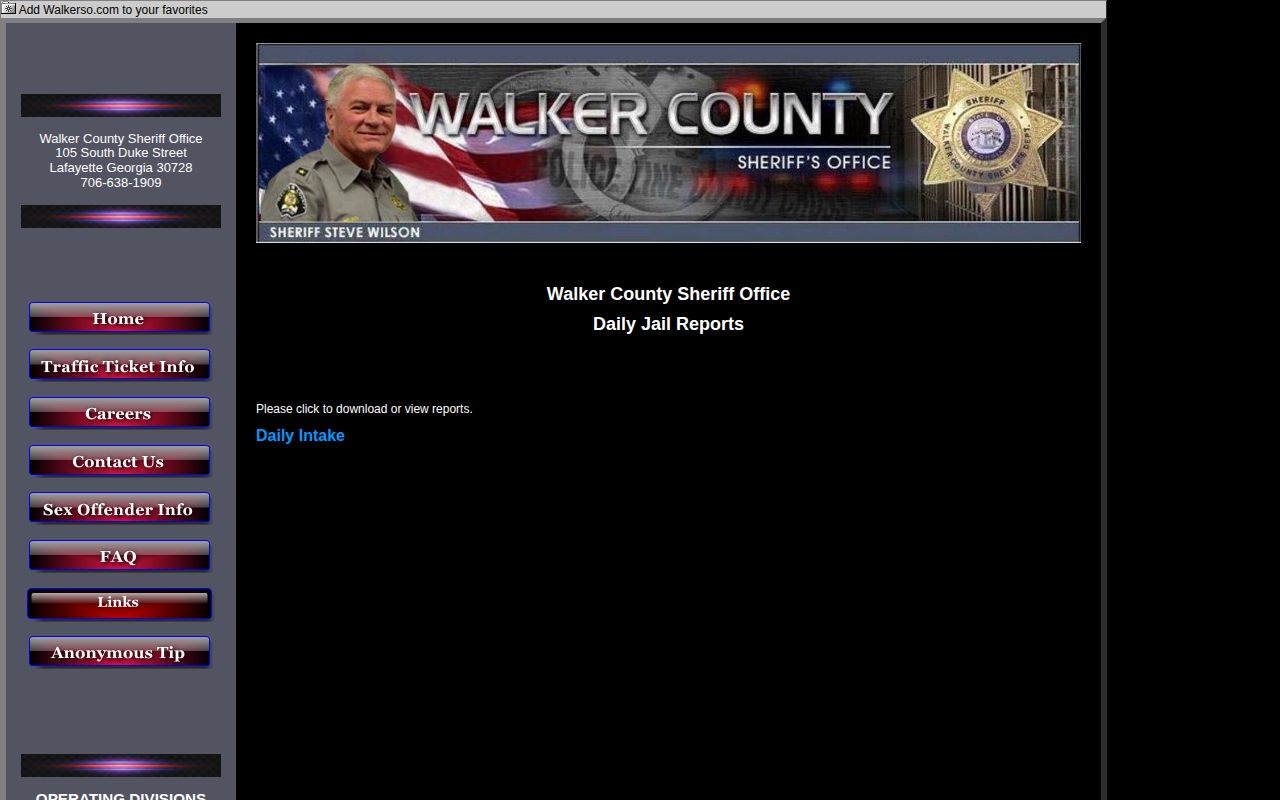
That report index shows a Daily Intake link and agency navigation. It has no stable Most Wanted count and no person-by-person wanted archive. Its value is context. It points to an official reporting channel while making clear why a dated social notice has to be checked on its own.
Note: A report index can document jail admissions, but it cannot establish that an unlisted person has no warrant.
What Walker County Notices Show
With no fixed WCSO list in place, the table below serves as a reading aid for a date-specific official notice. It separates what a post may actually contain from details that still need direct confirmation. Never fill in a missing field from a search result, a repost, or a name match.
A notice earns its keep when it gives law enforcement enough detail to act on a tip. It does not replace the issuing court's record. A missing photo, warrant number, court name, or located-status update is not evidence that the matter itself does not exist.
| Field | What it can and cannot verify |
|---|---|
| Publisher | Confirm that the post comes from the official WCSO account or a page reached through the sheriff's site. A copied post has no added authority. |
| Post date | Shows when the notice was displayed or updated. It does not prove when a warrant issued, expired, or was served. |
| Name and identity details | Use only the name and descriptors actually supplied. A matching name alone does not identify a person. |
| Allegation or warrant basis | Reports the language used by the agency. It is an charge, not a finding of guilt or a final charge disposition. |
| Photograph | A selected social notice may include an image, but no standing WCSO photo rule or public wanted gallery was verified. Do not assume one is available. |
| Current status | Only an explicit agency update can say that a person was located. A missing, removed, or old post does not prove release or resolution. |
| Tip route | Follow the contact method in the exact notice. No countywide anonymous reward amount or general Crime Stoppers policy was verified. |
Treat each notice like a booking report. The named person could be a suspect, a defendant with a court date coming, or someone whose warrant changed after the post went up. Confirmation rests with the court and the agency holding the file.
How to Read Walker County Notices
Start with the source, not the face. Open the WCSO page that carries the notice and note the post date. A repost by another account is not enough. Always go back to the original agency post. A search engine snippet does not count as an official update either.
Then separate a tip from a custody question. A wanted notice asks the public to share information with law enforcement, nothing more. It is not a green light to confront anyone, verify a home address, or run a private investigation of your own.
- Confirm the source. Check the WCSO site or its linked official social account, then note the date and exact wording of the notice.
- Read the charge. Keep the reported warrant or charge separate from a conviction. Do not add a motive, offense detail, or court result that the notice does not state.
- Check identity with care. A name or photograph can match more than one person. Avoid reposting personal details or trying to identify someone through public speculation.
- Send information to the agency. Use the tip contact in the notice. Call 911 when there is immediate danger. Use WCSO's published line for non-emergency information.
- Verify custody and records separately. For a booking or current jail question, use the county-wide Walker County record search and confirm with WCSO. A booking entry still does not provide the final court outcome.
Kept in that role, a notice does real work. It helps law enforcement find a person. What it cannot do is replace a full county warrant search or a court judgment.
Walker County Tips and Safety
WCSO can direct a tip through the contact method attached to a particular Facebook notice. That route may change from one post to the next. The research did not verify a single countywide anonymous Crime Stoppers line, a standard anonymity promise, or a standing reward amount. When a notice names a special tip service or reward, use the exact agency wording and do not enlarge it into a general policy.
For a non-emergency tip without a special contact in the notice, the sheriff's published main line is the practical starting point. A caller should provide the notice date, the person's name as printed, the location or information known, and a safe way for the agency to follow up if one is requested. Emergency danger belongs on 911. A tip should not be posted in a comment thread where an accusation can spread beyond the agency's request.
Walker County Sheriff's Office
105 South Duke Street
LaFayette, GA 30728
Main: 706-638-1909
Warrant line listed in the 2026 Georgia Sheriffs' Association directory: 706-670-1927
Emergency: 911
Why not just knock on a door? Confronting someone over a wanted notice is risky. A wrong identification could put a blameless neighbor in danger. A stale notice could spark a fresh incident instead of an arrest. Leave the approach to deputies, and let the record stay accurate in the meantime.
Check a Walker County Warrant
A fugitive listing on a website settles very little. It cannot confirm whether a named person actually has an active Walker County warrant. The WCSO website offers no public, name-searchable warrant portal. So treat this as two separate checks: the sheriff confirms the warrant, and the court or clerk answers questions about the case itself.
Start with a phone call. WCSO's main line is 706-638-1909, and the 2026 Georgia Sheriffs' Association directory lists a dedicated WCSO warrant line at 706-670-1927. Warrant applications, first appearances, preliminary and committal hearings, and permitted bail all run through Walker Magistrate Court, reachable at 201 South Duke Street in LaFayette, 706-638-1217. That court does not advertise a public warrant lookup. Ask the clerk which office actually holds the record you need.
State and Superior Court cases open other doors. The Georgia Courts e-access directory routes Walker State and Walker Superior matters to PeachCourt, which requires an account. The Walker County clerk docket is a second court route. A docket may show a filing or a case event, but it is not a live sheriff confirmation.
- Define the question. Gather the person's full name and other lawful identifying details, the possible court or agency, and the reason a current answer is needed.
- Call the sheriff. Ask WCSO or the listed warrant line which office can confirm the current law-enforcement status. Staff may limit details about protected or unserved material.
- Check the known court. Search PeachCourt through the Georgia Courts directory or ask the relevant clerk about a case number, filing, or court event. Do not treat an empty online result as proof that no warrant exists.
- Resolve the matter safely. A person who believes the warrant is theirs should speak with counsel and the court about the lawful next step. Do not hide, evade, or attempt to work around a warrant.
Custody is a separate question. A person can hold an active warrant and still walk free. Someone sitting in the Walker County Detention Center might even be booked on another county's paper. For current jail status, use WCSO's AIS or VINELink. Do not read custody into a court filing.
Walker County Warrant Types
Warrant labels are legal terms. They are not a public menu of categories that Walker County happens to publish. Treat the distinctions below as rough orientation. The issuing court, the case record, and the law-enforcement custodian control the exact label and its current status.
| General label | Plain meaning | Walker County check |
|---|---|---|
| Arrest warrant | A court-authorized process connected to an alleged offense and the taking of a person into custody. | Ask WCSO which agency and court hold the current confirmation. A public notice is not required. |
| Bench warrant | A court-issued process tied to a court proceeding or a person's failure to meet a court requirement. | Ask the relevant clerk or court for the case event, then confirm current status with law enforcement. |
| Search warrant | Authority to search a place or thing. It is not the same as a public notice that a person is wanted. | Do not use a search-warrant record as a custody check or as proof that a person was charged. |
Local paperwork may use different wording. Some material stays closed until service, or under a statutory exception. When the stakes are personal, let an agency, clerk, or lawyer explain the record. A third-party label should never carry that weight.
Walker County Court Follow-Up
A fugitive listing only tells part of the story. The case itself moves through the courts. Walker Magistrate Court typically handles first appearances and warrants. Misdemeanors and traffic matters usually land in Walker State Court, while felonies go to Walker Superior Court. The charging papers and the docket control where a case belongs, so treat the felony or misdemeanor label on a daily report as a rough clue rather than the final word.
Georgia's e-access portal works for tracking Walker State or Superior cases. Confirm the case number and the person's identity before trusting the docket. Dockets can show indictments, motions, pleas, dismissals, sentences, or convictions. Electronic coverage has gaps, though. For certified copies or older, unindexed files, the clerk's office is the way to go.
State custody brings a different search. When a Walker County case ends in a prison term or state supervision, try the Georgia Department of Corrections Find an Offender query. That state record stands apart from a county warrant notice, a WCSO booking entry, or a court docket.
Federal and immigration custody are separate systems too. The Bureau of Prisons locator and ICE locator cover those cases. A missing county notice means nothing there, so don't assume local custody either way.
Three terms to keep straight
- Warrant
- A court-related authorization or order tied to a law-enforcement or court action. The exact kind and status must be confirmed with the issuing court or agency.
- Booking
- The jail intake process after an arrest or custodial transfer. A booking records an administrative event and charges received at intake.
- Disposition
- The court's later outcome in a case, such as dismissal, plea, acquittal, or conviction. A wanted notice cannot supply it.
A booking that follows a wanted notice splits into separate channels again. WCSO answers the custody question. The records custodian holds whatever booking file can be released. The court tracks what happened with the charges. No photo or social media post can stand in for that paper trail.
Walker County Social Alerts and AIS
WCSO has no verified sheriff mobile app with an inmate-photo function. Its homepage does embed official Facebook content. That makes social posts a decent alert channel, though far from a complete ledger. The office also links NCIC for inmate video visits, a service that lets known inmates communicate with the outside. It is not a wanted-person search or a booking-photo lookup.
For who is currently housed, the official Automated Inmate System instructions give a phone path. Call 706-638-1909, press 3 for Detention, then press 1 for AIS. Searches run by last name or date of birth. Expect delays. Processing and booking can take eight hours or more before anything appears. AIS shows no photographs, and WCSO does not publish its full list of returned fields or say how long data persists after release.
Those instructions matter for one reason. They mark the line between a current-custody channel and a wanted notice. AIS creates no gallery, and an empty result during the processing window proves nothing about release.
The official AIS page lays out the phone path, the eight-hour-or-more processing warning, and the two search fields. It serves one purpose: checking current custody. It does not show that WCSO publishes official wanted photos or any searchable warrant list.
Note: VINELink can send custody-change alerts, but it is not a mugshot archive, court docket, or warrant confirmation.